Is Uncomplicated Caesarean Delivery Safer Following the Ultra-short Stay Post-operative Management Protocol than the Traditional Protocol? A randomized Controlled Trial
Keywords:
readmission, puerperal sepsis, wound sepsis, spinal headache, safetyAbstract
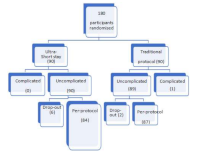
Background: Caesarean delivery is currently the commonest major operation in Obstetrics worldwide, and is presently safe. Post-operative management protocols should therefore be reviewed to reduce hospital stay after the procedure, with post-operative safety guaranteed. Methods: This was a randomized controlled trial conducted in 3 centres in Bayelsa state, Southsouth Nigeria. Federal Medical Centre, Yenagoa; Niger Delta University Teaching Hospital, Okolobiri, and Diete-Koki Memorial Hospital, Opolo with 179 women who just had uncomplicated Caesarean delivery were randomized into ultra-short stay(90) and traditional groups(89). The ultrashort stay group had minty chewing gums for 2 hours after surgery, started ambulating and taking orally from 6 hours(regular diet from 12 hours); and urethral catheter discontinued 6-12 hours postoperative. The traditional group commenced ambulation 12-24 hours, oral intake initiated and urethral catheter discontinued at 24 hours post-operative. In the ultra-short stay group, wounds were exposed and patient discharged at 36-48 hours post-operative. In the traditional group, patient was discharged on day 3-5. Both groups were counselled on wound care at discharge. Safety outcomes were recorded during the postnatal visits. Results: There was no difference in occurrence of spinal headache(X2 <0.01,p=0.977), wound sepsis(X2 <0.01,p=0.983), and puerperal sepsis(X2 =2.05,p=0.153) between the 2 groups, but a higher rate of readmission in the traditional than the ultra-short stay group(X2 =4.14,p=0.042). There was no maternal mortality. Conclusion: Safety (spinal headache, wound sepsis, puerperal sepsis) after uncomplicated Caesarean, is the same in the ultra-short stay and the traditional protocol, which has a higher readmission rate. The ultra-short stay post-operative management protocol is therefore recommended after uncomplicated Caesarean section.Downloads
References
1. Betran AP, Ye J, Moller AB, Souza JP, Zhang J. Trends and projections of caesarean section rates: global and regional estimates. BMJ Glob
Health. 2021 Jun;6(6):e005671.136/bmjgh-2021-005671. PMID:34130991; PMCID: PMC8208001.
2. Oyeyemi N, Oyeneyin L, Oluwole A, Oyeyemi A, Afolabi B. Postoperative management in uncomplicated caesadoi:10.1rean delivery: A randomised trial of short-stay versus traditional protocol at the Lagos University Teaching Hospital, Nigeria. Niger Postgrad Med J, 2019. Jan-Mar; 26(1):31-37. doi :10.4103/npmj_166_18. PMID:30860197.
3. The CAESAR study collaborative group. Caesarean section surgical techniques: a randomised factorial trial (CAESAR). BJOG 2010; 117:1366–1376.
4. Ghaffari, P., Vanda, R., Aramesh, S. et al. Hospital discharge on the first compared with the second day after a planned cesarean delivery
had equivalent maternal postpartum outcomes: a randomized single - blind controlled clinical trial. BMC Pregnancy Childbirth 21, 466 (2021).
https://doi.org/10.1186/s12884-021-03873-8.
5. C. Gialdini, M. Chamillard, V. Diaz, et al. Evidence-based surgical procedures to optimize caesarean outcomes: an overview of systematic reviews EClinicalMedicine, 72 (2024), Article 102632
6. Kruse AR, Lauszus FF, Forman A, Kesmodel US, Rugaard MB, Knudsen RK, Uldbjerg N, Sundtoft IB. Effect of early discharge after planned cesarean section on recovery and parental sense of security. A randomized clinical trial. Acta Obstet Gynecol Scand. 2021 May; 100(5):955-963. doi: 10.1111/aogs.14041. Epub 2020 Dec 25. PMID: 33179268
7. Incerpi MH. Operative Delivery. In: DeCherney AH, Nathan L, Laufer N, Roman AS (eds). Current Diagnosis and Treatment in Obstetrics & Gynaecology. 12th edition McGraw Hill Education. 2019: 341-348.
8. Otubu JAM, Pam IC. Caesarean Section. In: Olalekan Abudu, Joseph Otubu (eds). Agboola's Textbook of Obstetrics and Gynaecology for
Medical Students, third edition, Heinemann Educational Books (Nigeria) Plc pub 2021, pp 585-593.
9. Jabbari A, Alijanpour E, Mir M, Bani Hashem N, Rabiea SM, Rupani MA. Post spinal puncture headache, an old problem and new concepts:
review of articles about predisposing factors. Caspian J Intern Med. 2013 Winter;4(1):595-602. PMID: 24009943; PMCID: PMC3762227.
10. Abrahamson JH, Abrahamson ZH (eds). Clinical Trials. Research Methods in Community Medicine 6th ed. John Wiley and Sons Ltd, 2008: 325-344.
11. Handbook on Reproductive Health indicators, United Nations. New York, 2001. Introduction, page13. Cited at http://www.unescap.org
/esid/psis/publications/handbookhealth/handbook.pdf on 15/09/11.
12. Abrahamson JH. WINPEPI (PEPI-forWindows): computer programs for epidemiologists. Epidemiologic Perspectives & Innovations 2004,
1:6.
13. Onu FA et al. Maternal and Neonatal Outcome following Day Two versus Day Five or Seven Discharge after an Uncomplicated Elective Caesarean Section: A Randomized Control Study. Biomed Res Int. 2021. PMID: 34977248
14. Oyeyemi N, Onwudiegwu U, Pughikumo D, Oyeyemi AS.Perception of Caesarean delivery by patients and their care-givers in the
ultra- short s tay ver sus the traditional post-operative management protocol, following uncomplicated Caesarean delivery: a randomized controlled trial. Niger Delta J Med Med Res. 2025;4(2):52–60.
15. Vallejo MC, Mandell GL, Sabo DP, Ramananathan S. Postdural Puncture Headache: A Randomized Comparison of Five Spinal Needles
in Obstetric Patients. Anesth Analg. 2000;91:916-20. doi: 10.1097/00000539-200010000-00027. [DOI][PubMed] [Google Scholar]
16. Fassoulaki A, Petropoulos G, Staikou C, Siafaka I, Sarantopoulos C. General versus neuraxial anaesthesia for Caesarean section: impact on the duration of hospital stay. J Obstet Gynecol. 2009 Jan; 29(1)25-30.
17. Oyeyemi N, Afolabi BB, Oyeneyin OL, Oyeyemi AS. Are patients more satisfied with the short-stay than the traditional protocol following
uncomplicated Caesarean delivery? A clinical trial in the Lagos University Teaching Hospital (LUTH), Nigeria. Niger Delta J Med Med Res. 2024;4 (1):42–51.
18. Fasubaa OB, Ogunniyi SO, Dare FO, Isawumi AI, Ezechi OC, Orji EO. Uncomplicatedcaesarean section: is prolonged hospital stay necessary?
East Afr Med J 2000;77:448-451.
19. Matthew Anyanwu, Admire Coker, Donkor Simon. Prevalence of Dural Puncture headache after caesarean section at a Tertiary Hospital in
Gambia. doi: https://doi.org/10. 1101/2024.04.25.24306406
20. Hayman R. Caesarean section. In: Luesley DM, Baker PN (eds). An evidence-based text for MRCOG, 2nd edition. Hodder Arnold 2010; 401-
12.
21. Hofmeyr GJ, Smaill F. Antibiotic prophylaxis regimens and drugs for caesarean section. Cochrane Database Syst Rev 2000; (2): CD001136.
22. Bagrates JS, Moodley J, Kleinschmidt I, Zawil ski W. A randomi sed controlled trial of antibiotic prophylaxis in elective Caesarean delivery. Br J Obstet Gynaecol 2001; 108: 143-8.
23. Liu S, Heaman M, Kramer MS, Demissie K, Wen SN, Marcoux S. Length of hospital stay, Obstetric Conditions at Childbirth, maternal readmission: a population-based cohort study. Am J Obstet Gynecol. 2002 Sep; 187(3): 681-7.
Published
Issue
Section
License

This work is licensed under a Creative Commons Attribution-NonCommercial-ShareAlike 4.0 International License.
All articles published in the journal are licensed under a Creative Commons Attribution (CC BY) license(i.e CC Attribution-NonCommercial-ShareAlike 4.0), allowing others to share, distribute, and build upon the work, provided the original author(s) and source are properly cited. Authors retain the copyright of their work.